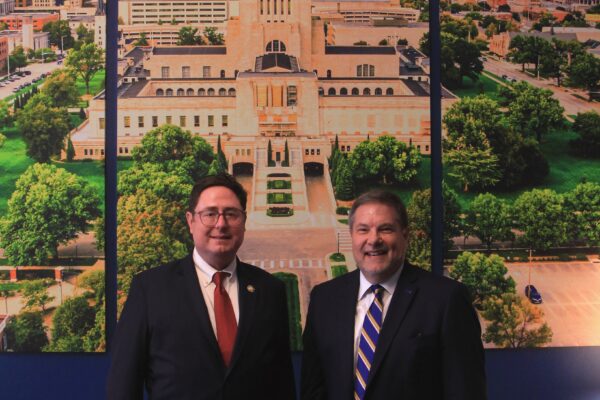
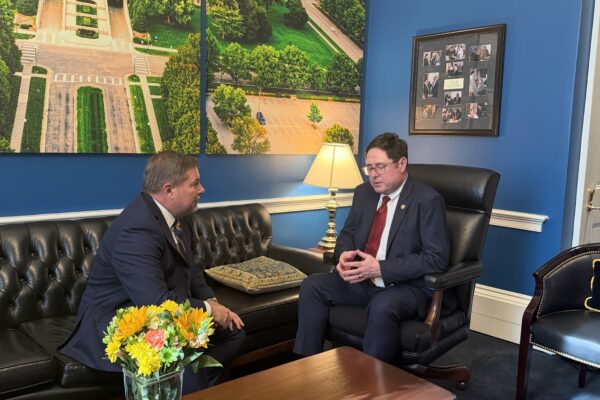
Inside Congress: Rep. Mike Flood Talks Terrorism Insurance, Housing and Politics
One of the most rewarding parts of advancing a major piece of legislation is the opportunity to truly get to know the Members of Congress who are shaping it from the inside. Such is the case with Rep. Mike Flood (R‑NE), the lead sponsor of H.R. 7128, the TRIA Program Reauthorization Act of 2026—and the bipartisan legislation that represents BOMA International’s top legislative priority this year.
Congressman Flood represents Nebraska’s First Congressional District, a region that includes Lincoln, Norfolk, and much of eastern Nebraska, and has served in the U.S. House of Representatives since mid‑2022. Before coming to Congress, he served multiple terms in Nebraska’s unicameral legislature and, notably, was elected Speaker of the Nebraska Legislature, becoming the youngest Speaker in state history. During his tenure, he was known for navigating complex policy challenges, building consensus, and managing large‑scale legislative priorities—experience that continues to inform his approach to policymaking in Washington.
In the 119th Congress, he serves on the House Financial Services Committee and is Chairman of the Housing and Insurance Subcommittee, placing him at the center of federal policy discussions on insurance markets, housing affordability, and risk management. As sponsor of H.R. 7128, he has worked in a bipartisan fashion on the Committee to extend and modernize the Terrorism Risk Insurance Program, recognizing its essential role in protecting commercial assets, supporting economic growth, and safeguarding communities against catastrophic risk.
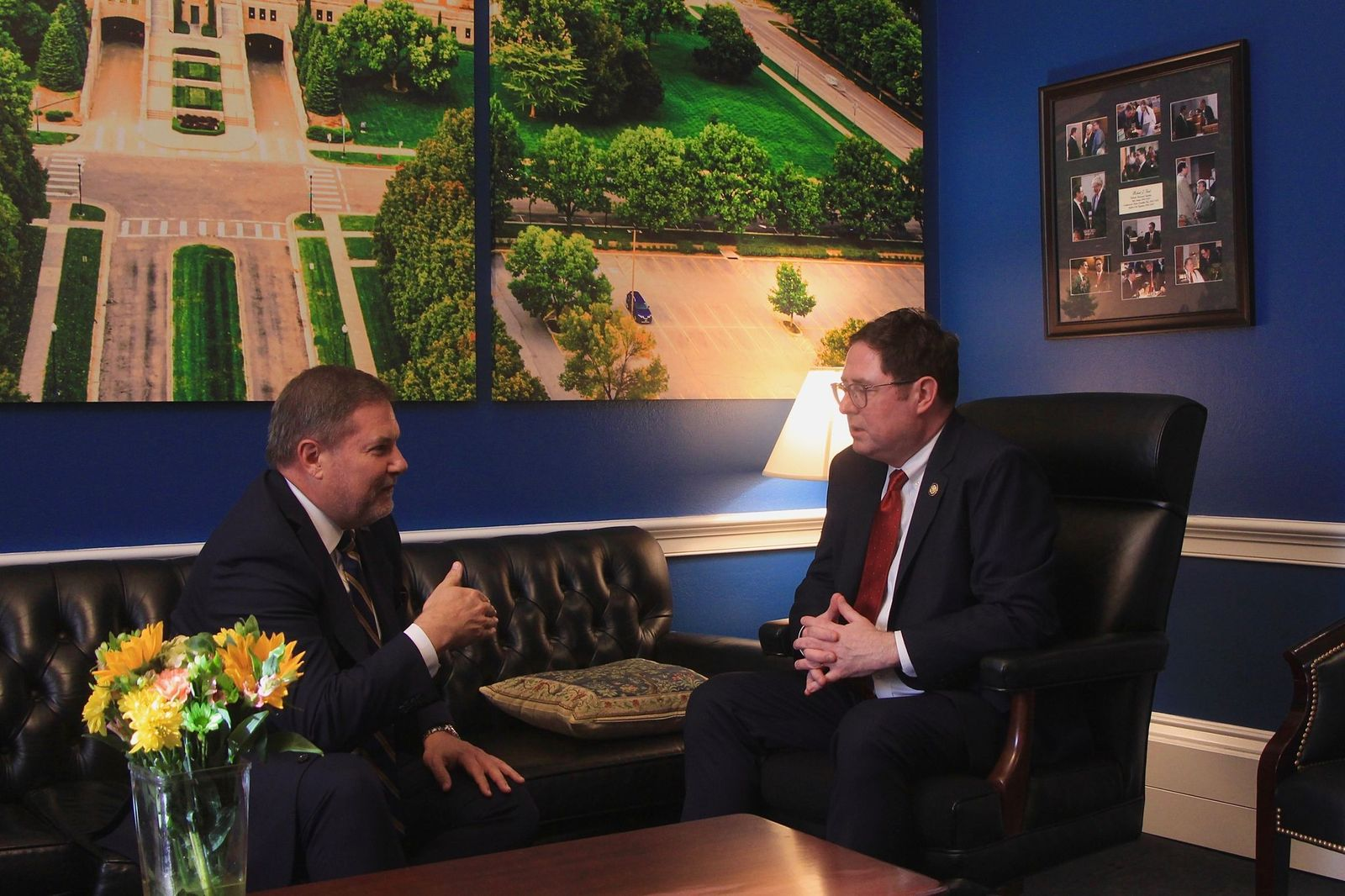
Jeff Janas, BOMA International’s Director of Federal Affairs, recently had the opportunity to sit down with Rep. Flood to discuss his path to Congress, his work on housing and insurance policy, and why TRIA reauthorization remains so critical to the nation’s economy and the commercial real estate industry. What follows is that conversation with one of Congress’s key leaders on this issue.
Q1: Nebraska is the only state in the nation with a unicameral legislature. You served a total of nine years there, including six as Speaker. What leadership skills or governing perspectives from that experience have most shaped how you operate in Congress today?
My work in the nonpartisan Unicameral Legislature taught me how to work with Republicans and Democrats alike to get things done for the people I represent. That bipartisan approach has carried over into my work in Congress. I am proud to collaborate with members from both parties, particularly my colleagues from across the aisle on the House Financial Services Committee—such as Representatives Emanuel Cleaver (MO-2), Brittany Pettersen (CO-7), and Sam Liccardo (CA-16)—on issues like the reauthorization of the Terrorism Risk Insurance Act (TRIA), housing, artificial intelligence, and a range of other important priorities.
Q2: BOMA strongly supports reauthorizing the Terrorism Risk Insurance Act (TRIA), which allows insurers to offer terrorism coverage and enables our members to secure the insurance necessary to access financing and protect their properties. As the 2014 lapse demonstrated, even brief disruptions can destabilize the commercial real estate market—cutting off access to capital and placing some owners in technical default.
Your bill, the TRIA Program Reauthorization Act of 2026 (H.R. 7128), would provide a seven‑year extension and the long‑term certainty the market needs. As you move this legislation forward, how do you see the process unfolding, and how can stakeholders best support its successful passage?
We are hopeful to get the TRIA Program Reauthorization Act onto the House floor as soon as possible. Once it’s on the floor, we believe the bill will pass by a strong, bipartisan vote. Then, it is our hope that the United States Senate will take the bill up and pass it this year. I have heard from BOMA, the insurance industry, and other stakeholders that we need to get TRIA extended this year to provide certainty and stability to the market. I believe we’re on track to get that done. We appreciate BOMA’s early and strong support for TRIA reauthorization in the committee.
Q3: The Housing for the 21st Century Act, the House’s major housing package, originated in your subcommittee. As you know, there are significant differences between the House‑passed bill and the Senate’s version. The House approach focuses on expanding supply through regulatory and financing reforms, while the Senate pairs those measures with affordability‑driven interventions, including limits on large institutional ownership of single‑family rentals—an approach supported by the White House.
Given these differences, where do you see the most realistic path forward this year, and what outcomes should property owners and managers be watching most closely? where do you see the most realistic path forward this year, and what outcomes should property owners and managers be watching most closely?
While differences between the House and Senate housing packages certainly exist, I want to start with the good news: we have both chambers of Congress and the White House all working towards meaningful, comprehensive housing legislation.
I have been consistent in saying that the best path forward is for the leaders of both the House and Senate committees on the issue—Chairman French Hill (AR-2) and Ranking Member Maxine Waters (CA-43) of the House Financial Services Committee, and Senate Banking Chairman Tim Scott (SC) and Ranking Member Elizabeth Warren (MA)—to sit down and hash out the differences between the two bills so we can move forward on a product each Chamber can support.
However, if an informal conference process isn’t possible, then I am confident Chairman Hill and Ranking Member Waters will work together to remedy some of the problems with the current Senate language and produce a stronger, bipartisan product.
Q4: There are 79 local BOMA associations around the country represented by over 250+ Member of the House and 78 Senators, including BOMA Omaha. Based on your experience, how would you recommend they engage most effectively in the legislative process?
My advice would be to build a relationship with the Members and Senators that represent you early—well before you need to go to them with an ask. If an urgent issue for your business is in front of Congress and you are just starting to build your relationship with your Member, you’re likely behind the eight ball. It’s much better to develop a relationship first, and then when something urgent comes up, you’re in a better position to work with your elected representative to find a solution.
Q5: When your time in Washington eventually comes to a close, how do you hope your constituents will remember your service?
The Nebraska delegation is small relative to most other states; we only have 5 total elected representatives. As a result, we all need to go above and beyond to ensure that Nebraskans are getting the representation they deserve in the Capitol. Whenever my congressional career concludes, I hope the people of Nebraska’s First Congressional District feel they had a strong voice who consistently advocated for our state’s needs in the federal government.